The Man Behind the Music: Philip Glass
Composer and performer Philip Glass has developed a voice all his own. Known for his persistent, pulsating work, the composer has had an immeasurable impact on modern music. Primarily known for his operas and film scores, Glass has also written several compositions for dance. Keep reading to learn more about this composer’s life and work!
Early Life and Training
Philip Glass was born in Baltimore, Maryland, to Latvian and Russian Jewish emigrants. He demonstrated his musical talent from a young age, starting with the violin at the age of six. He also worked at his father’s record store. There, he was exposed to an eclectic array of musical styles while processing inventory and ordering records for the classical music section. When he was 15, he enrolled at the University of Chicago to study Mathematics and Philosophy. Glass remembers wondering, “Where does music come from?” while a young student. This is when he first became interested in composing.

Philip Glass in Florence, Italy, 1993
At age 19, Glass began serious studies of composition at Juilliard. Shortly after graduation, Glass was awarded a Fulbright Scholarship, allowing him to travel to Paris and study with legendary teacher Nadia Boulanger (she trained Aaron Copland, Virgil Thomson, and Quincy Jones, among others). Glass’s time in Paris was highly influential. There, he was first exposed to Indian sitarist Ravi Shanker. Shanker’s approach to harmony, tempo, and melody changed Glass’ understanding of music. Glass explored the contemporary theater scene and French New Wave films, fascinated by the interplay between images, movement, and text. He also “spent a lot of time in the theater,” and “began to understand it” by watching lighting rehearsals, observing costumers, and more.
Early Career and Operas
In the late ‘60s, Glass moved to New York, working as a taxi driver and a plumber to support himself. Unable to find a group capable of performing his unique compositions, he founded his own. In 1968, Glass established the Philip Glass Ensemble, which features amplified woodwinds, keyboard synthesizers, and vocalists. The Ensemble continues to perform Glass’s music today!
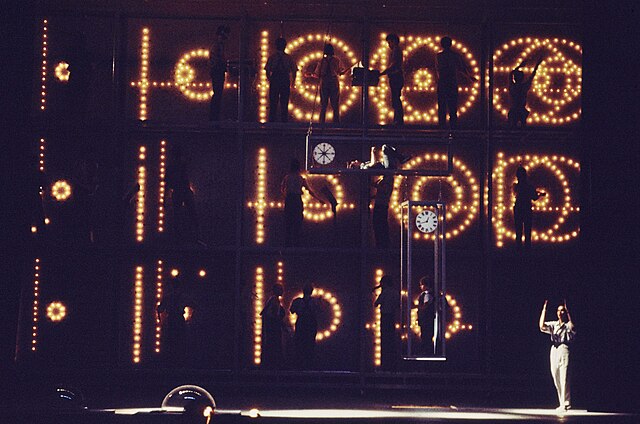
1976 performance of Einstein on the Beach, photo by Fernand Michaud.
Glass’s career was transformed by the 1976 premiere of his opera Einstein on the Beach. Quickly, he went from performing for six audience members (including his mother) to seeing his work onstage at the Metropolitan Opera House. He reflects that there, “must have been an urgent need for a big change to happen.” The opera itself is non-narrative, loosely based on Albert Einstein’s life. It is composed of four scenes and five intermezzos (or “knee plays”). Einstein on the Beach is a prime example of Glass’s unique style, which he himself describes as “music with repetitive structures.” Together, Glass’s trio of operas, Einstein on the Beach, Satyagraha (1980), and Akhenaten (1983) tackle themes of science, politics, and religion, each inspired by a real-world figure.
Music for Dance
In addition to opera, Glass created several musical works for dance. Interested in collaboration since his time in Paris, Glass has frequently worked with dance companies and artists. He would charge dance companies $5.00 for every performance that used his music. Working with many small, unsuccessful groups, he shares that dance companies “never had to pay me until they got to $25.00, which they never did.” More successful collaborations began with choreographer Lucinda Childs’ contributions to Einstein on the Beach. In 1983, Jerome Robbins’ Glass Pieces premiered at the New York City Ballet, set to excerpts of Glass’s work. Twyla Tharp has frequently collaborated with Glass, beginning with In the Upper Room in 1986. `
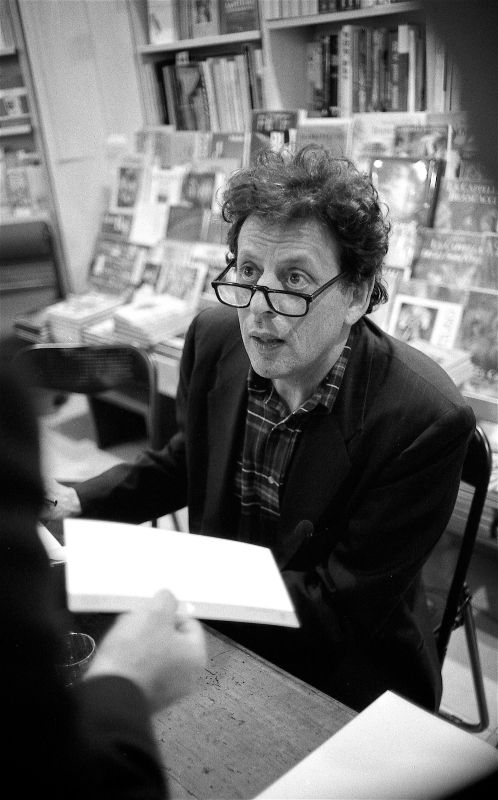
Philip Glass in Florence, Italy, 1993
Film Scores
Glass is also a prominent composer for cinema; he has written over 50 film scores. His interest in film began as early as 1966, when he was music supervisor for the underground movie Chappaqua. He wrote his first film score in 1982 for Koyaanisqatsi and has now received Academy Awards for Kundun (1997), The Hours (2002), and Notes on a Scandal (2006). Glass is also the recipient of a Golden Globe for his work in The Truman Show (1998) and a BAFTA Award for The Hours (2002) score. His music can also be heard in several episodes of the popular Netflix show Stranger Things.
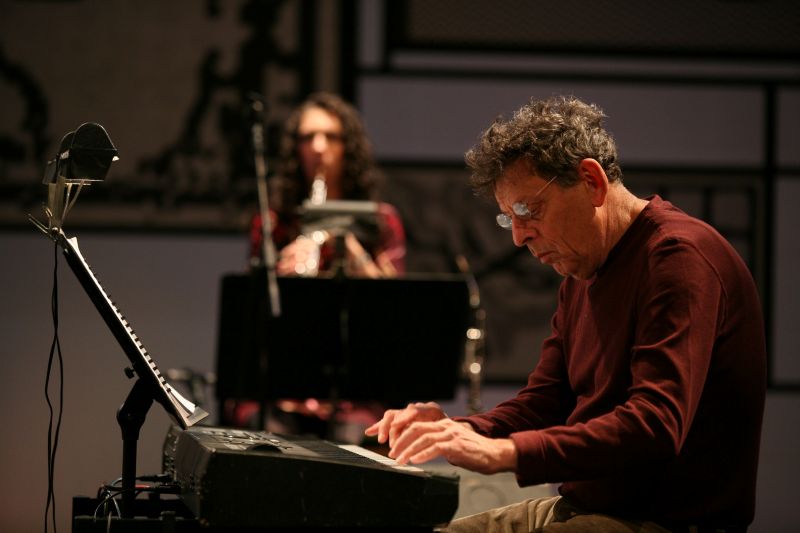
Philip Glass performs, photo © Lelli E. Masotti
Glass’s impressive career is ongoing. Thus far, he has composed 30 operas, 14 symphonies, thirteen concertos, multiple film scores, nine string quartets, and multiple pieces for solo piano and organ. He has collaborated with an eclectic range of musicians and artists, from kora player Foday Musa Suso to David Bowie. He is also the co-founder of the record label Orange Mountain Music. He continues to perform and compose.
See Philip Glass’s In The Upper Room, featuring live performances of the PNB Orchestra (“best ballet band in America,” according to The New York Times) onstage November 7 – 16, 2025!
Sources: Olsen, Andrew. (2025, April 17). Understanding Philip Glass in 5 Compositions. The Collector. Retrieved October 15, 2025, from https://www.thecollector.com/understand-philip-glass-compositions. Philip Glass Biography. Philip Glass.com. Retrieved October 15, 2025 from https://philipglass.com/biography. Philip Glass. English National Opera. Retrieved October 15, 2025, from https://www.eno.org/people/philip-glass. Philip Glass. Encyclopedia Britannica. Retrieved October 15, 2025 from https://www.britannica.com/biography/Philip-Glass.